The Power of Automated Intercompany Matching

Introduction
Over the last decade, transaction matching tools have evolved significantly, especially when combined with intelligent rules and automation capabilities.
For finance teams managing multiple entities, automated transaction matching plays a critical role in simplifying complex reconciliation workflows.
At Consarc, we have focused on building customizable transaction matching routines that allow finance teams to define reconciliation rules based on their specific accounting practices. This flexibility becomes particularly important when dealing with inter-company reconciliations during financial consolidation under Generally Accepted Accounting Principles (GAAP).
The Complexities of Inter-Company Reconciliation
Inter-company reconciliation is one of the most time-consuming processes in the financial close cycle. Several factors contribute to this complexity, especially for organizations operating across multiple entities and jurisdictions.
- Regulatory Deductions: Transactions between entities in different countries may be subject to taxes, withholding requirements, or other regulatory deductions. These variations can complicate reconciliation and require flexible matching rules.
- Foreign Exchange Differences: Subsidiaries often operate in different functional currencies. Exchange rate fluctuations introduce differences between transaction values, making accurate reconciliation more difficult.
- Multiple GAAP Books: Entities may maintain books under different accounting standards to comply with local regulations. Reconciling these variations into a consolidated financial statement requires systems capable of handling multiple accounting frameworks.
These examples highlight the level of sophistication required in transaction matching tools designed to support complex reconciliation workflows.
Rule-Based Transaction Matching Automation
Many reconciliation tools rely on basic matching logic, but real efficiency comes from customizable rule-based automation.
At Consarc, we recognize that while generic rules can provide a starting point, organizations often require tailored reconciliation logic based on their accounting processes.
Without this flexibility, finance teams may still spend significant time manually resolving unmatched transactions.
Inter-Company Reconciliations with Consarc
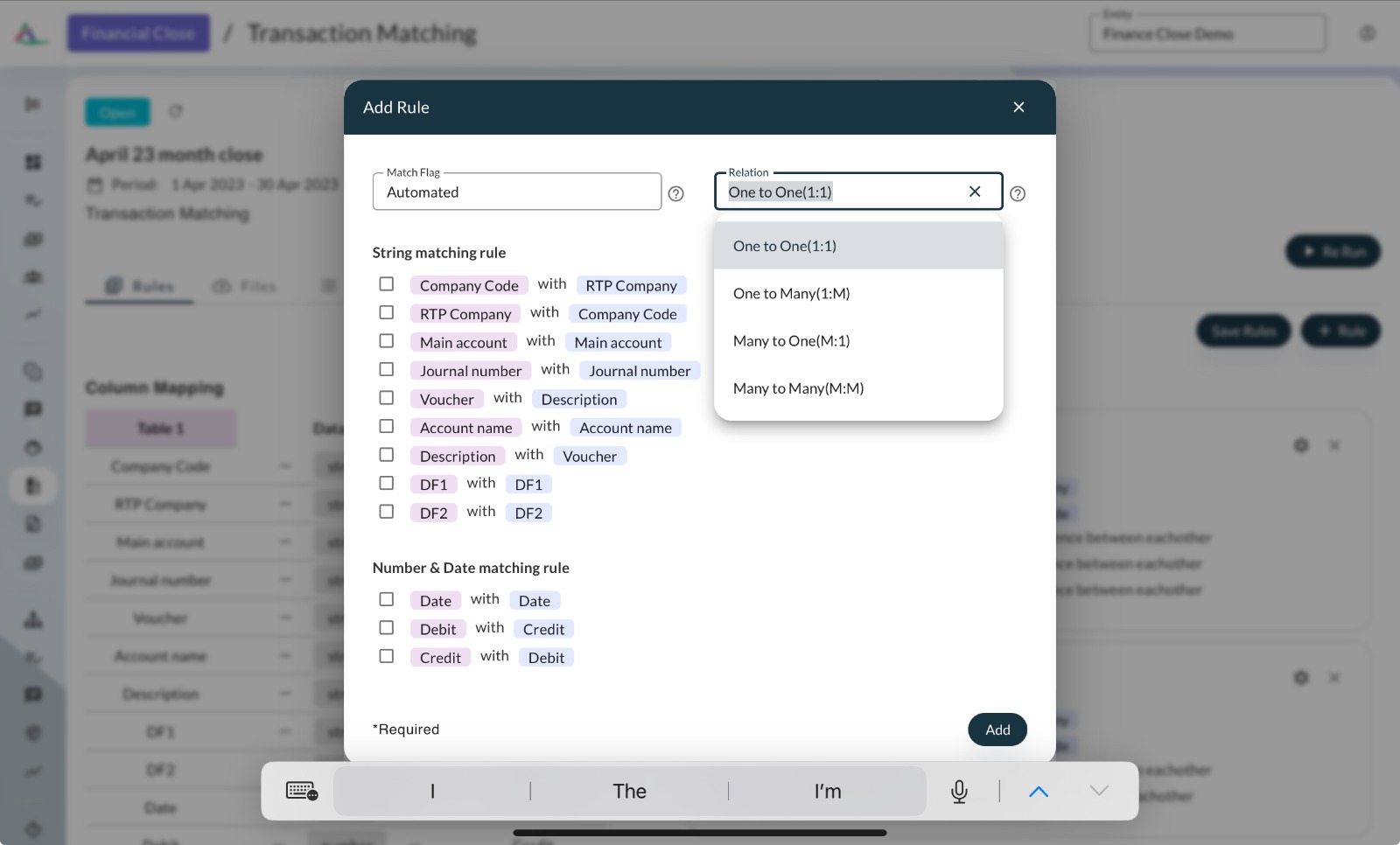
To address these challenges, Consarc’s transaction matching engine supports multiple reconciliation structures that reflect how finance teams typically match transactions.
The platform supports four primary reconciliation patterns:
- One-to-One: Matching a single transaction in one ledger to a single corresponding transaction in another ledger.
- One-to-Many: Reconciling one transaction against multiple related entries.
- Many-to-One: Matching multiple transactions against a single consolidated entry.
- Many-to-Many: Reconciling multiple transactions across two ledgers.
Finance teams can define multiple reconciliation rules within each category, allowing them to compare and reconcile transactions across ledgers according to their specific accounting practices.
Empowering Finance Teams with Intelligent Transaction Matching
Consarc’s transaction matching capabilities allow finance teams to design reconciliation rules tailored to their accounting processes.
This flexibility reduces manual effort, improves reconciliation accuracy, and accelerates the financial close cycle.
By combining intelligent automation with customizable matching logic, finance teams can manage even complex inter-company reconciliations with greater confidence and efficiency.
- Introduction
- The Complexities of Inter-Company Reconciliation
- Rule-Based Transaction Matching Automation
- Inter-Company Reconciliations with Consarc
- Empowering Finance Teams with Intelligent Transaction Matching
Related Blog





.png)
#447 Broadway, New York, NY 10013